
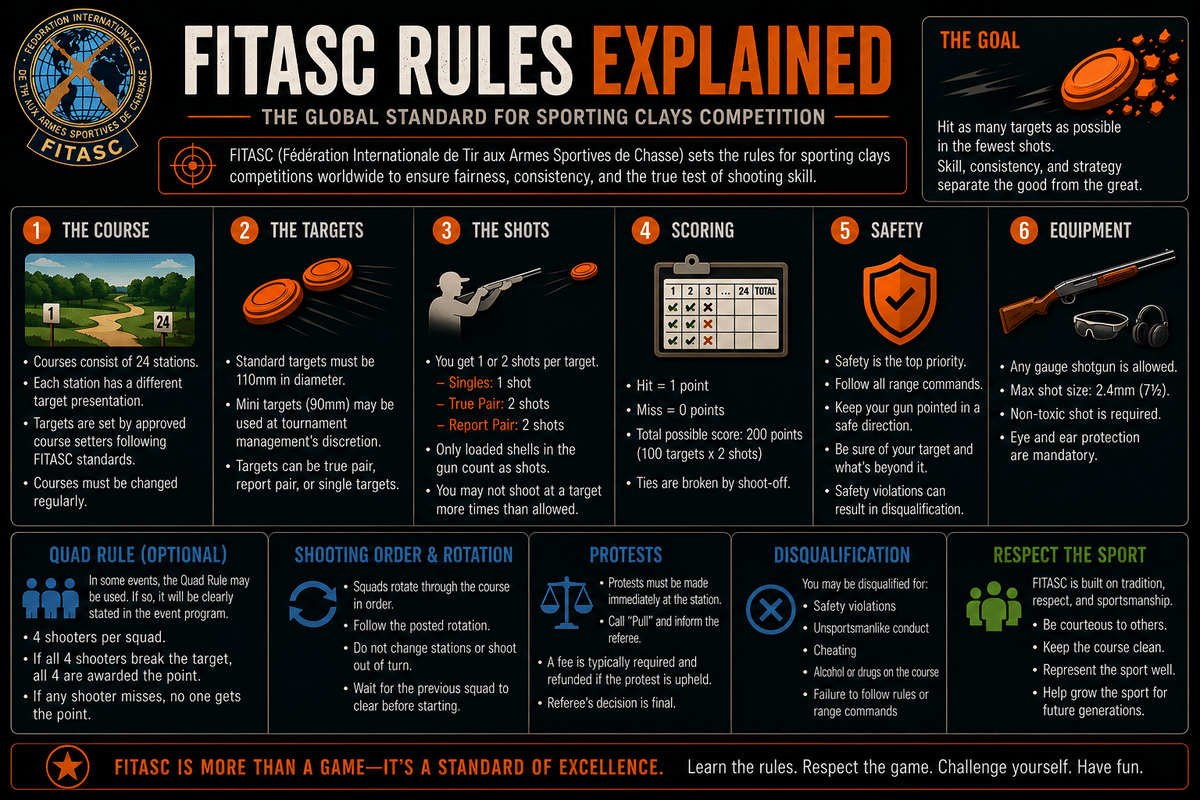
If you've spent time shooting sporting clays, you've probably heard shooters talk about FITASC. Pronounced "fee-task," FITASC is an international clay target discipline that challenges shooters with more structured shooting positions, target presentations, and rules than traditional sporting clays.
For many competitors, FITASC represents the ultimate test of shotgun skills. Understanding the rules can help you feel more comfortable stepping into your first competition and improve your performance on the course.
What Is FITASC?
FITASC stands for Fédération Internationale de Tir Aux Armes Sportives de Chasse, the international governing body for sporting shotgun disciplines.
FITASC Sporting combines the target variety of sporting clays with additional restrictions that emphasize gun handling, consistency, and target-reading skills. While sporting clays often allows shooters more flexibility, FITASC requires shooters to follow specific procedures before and during each shot.
The result is a discipline that rewards precision, discipline, and preparation.
How a FITASC Course Is Organized
A FITASC competition is divided into several shooting areas called parcours.
Each parcours contains multiple shooting stations known as pegs. Shooters rotate through the pegs while engaging a variety of target presentations.
Common FITASC target presentations include:
Crossing targets
Quartering targets
Incoming birds
Outgoing birds
Teal targets
Rabbits
Chandelles
Driven birds
The goal is to break as many targets as possible while following strict shooting procedures.
The Ready Position Rule
One of the biggest differences between FITASC and sporting clays is the required ready position.
Before calling for the target:
The shotgun butt must be positioned below the shoulder.
The buttstock must remain below a designated line across the shooter's vest or clothing.
The gun cannot be mounted before the target appears.
Once the target is visible, the shooter mounts the shotgun and fires.
This rule places a premium on timing, gun mount consistency, and target acquisition.
Target Menus and Sequences
Each peg offers a predetermined menu of targets.
Shooters may encounter:
Single Targets
One target launched after the shooter's call.
Report Pairs
The second target is released after the first shot is fired.
Simultaneous Pairs / True Pairs
Both targets are launched at the same time.
Following Pairs
A combination of target types depending on the competition format.
The order and presentation are established before shooting begins and remain the same for all competitors.
Viewing Targets Before Shooting
Before competition begins, shooters are usually shown demonstration targets.
This allows competitors to:
Observe flight paths
Determine break points
Develop a shooting plan
Select target order on pairs
Unlike hunting, FITASC rewards careful observation and preparation before stepping into the shooting stand.
Peg Rotation
Shooters rotate through each peg in a squad.
A typical squad consists of several competitors who take turns shooting until everyone has completed the required targets at that station.
Squad members are expected to maintain safety, observe etiquette, and assist with scoring when needed.
Scoring in FITASC
Scoring is straightforward:
Broken target = 1 point
Missed target = 0 points
A visible piece must separate from the target to count as a hit.
Most FITASC competitions consist of:
50 targets
100 targets
200 targets
The shooter with the highest score wins.
Safety Requirements
Safety is strictly enforced in FITASC competition.
Key safety rules include:
Muzzles must remain pointed in a safe direction.
Shotguns must remain open and unloaded when not shooting.
Ammunition may only be loaded when it is the shooter's turn.
Eye and ear protection are required.
Any unsafe gun handling may result in penalties or disqualification.
Competitors should always review event-specific safety procedures before participating.
Common FITASC Penalties
Penalties may be assessed for:
Premature gun mounting
Failure to maintain the proper ready position
Safety violations
Shooting out of turn
Incorrect target engagement procedures
Repeated violations can lead to lost targets or disqualification.
Tips for New FITASC Shooters
Practice Your Gun Mount
Since FITASC requires a low-gun start, a smooth and consistent mount is essential.
Watch Every Target
Observe demonstration birds carefully and learn from squad members who shoot before you.
Develop a Plan
Know your hold point, pick-up point, and intended break point before calling for the target.
Stay Patient
FITASC can feel challenging at first because of the low-gun requirement. Most shooters improve significantly with practice.
Focus on Consistency
The shooters who perform best are often those with the most repeatable pre-shot routine.
Final Thoughts
FITASC is one of the most rewarding and challenging shotgun disciplines in the world. By combining the variety of sporting clays with stricter shooting procedures, it tests every aspect of a shooter's ability—from gun handling and target reading to concentration and discipline.
For shooters looking to take their sporting clays skills to the next level, learning FITASC is an excellent way to become a more complete shotgun competitor. While the rules may seem intimidating at first, understanding the fundamentals will help you approach your first FITASC event with confidence and enjoy one of the most respected clay target sports in the world.