
Why Reading Targets Matters
Many shooters believe missed targets are caused by poor shooting technique. In reality, a large percentage of misses occur before the gun is ever mounted.
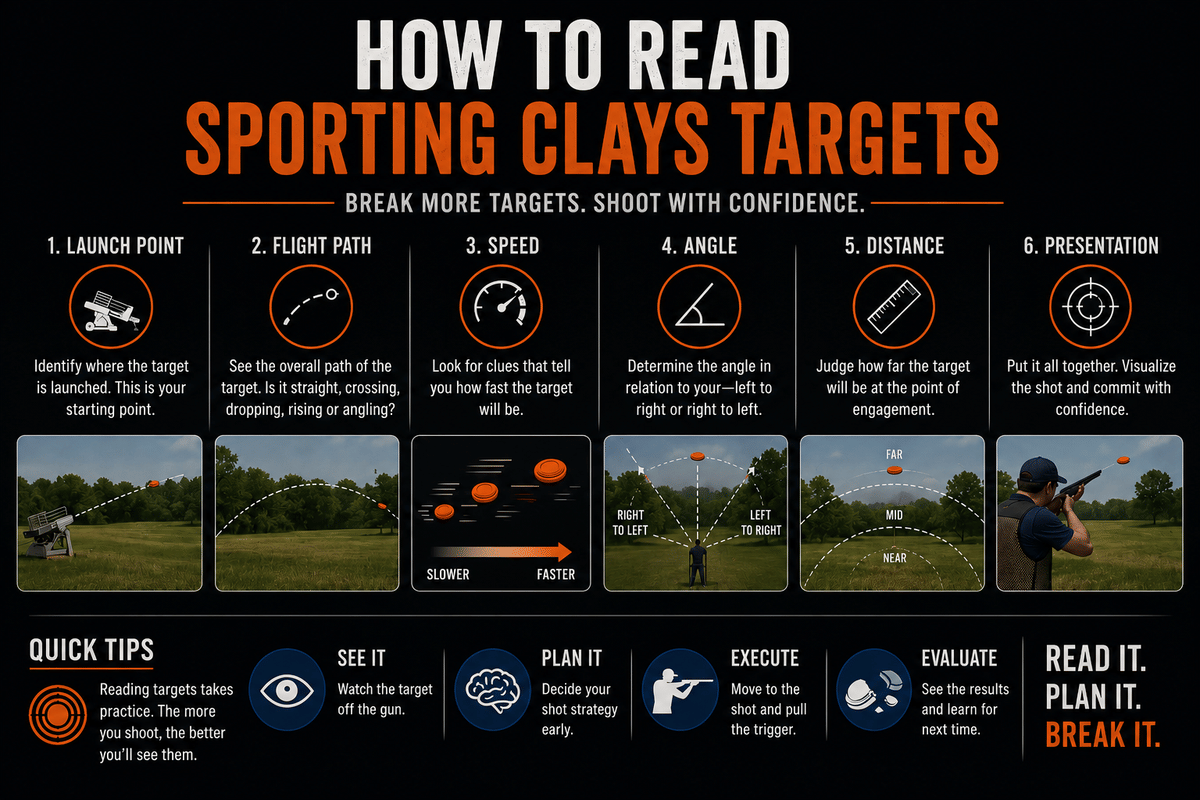
The best sporting clays shooters spend time analyzing the target before stepping into the station. Understanding a target's speed, angle, line, and break point allows shooters to develop a plan before calling "pull."
Target reading is the process of identifying how a clay moves through the air and determining the best place to break it.
What to Look for Before You Shoot
Before loading your gun, watch several target presentations and focus on four key elements:
Target Line
The line is the path the target follows through the air.
Ask yourself:
Is the target crossing left to right?
Is it crossing right to left?
Is it incoming?
Is it outgoing?
Does it quarter toward or away from you?
Understanding the line helps determine where the target can be seen most clearly.
Target Speed
Many shooters misjudge target speed.
Watch the target all the way through its flight.
A target that appears fast near the trap may actually slow dramatically as it reaches its apex. Others maintain speed throughout the presentation.
Never choose a break point based solely on how the target looks immediately after launch.
Target Height
Height changes can create visual deception.
Look for:
Rising targets
Falling targets
Peak points
Areas where the target flattens out
Targets are often easiest to break when vertical movement is minimized.
Background
The background can make a target appear easier or harder to see.
Identify:
Trees
Sky
Shadows
Sun position
Dark or light backgrounds
Choose a break point where visibility is greatest.
Finding the Break Point
The break point is where you intend to shoot the target.
Good break points are:
Clearly visible
Predictable
Repeatable
Poor break points are:
Too close to the trap
Hidden by background clutter
At maximum range
In areas where the target changes direction
The best shooters pick the break point first and build the rest of their plan around it.
Identify the Hold Point
The hold point is where the gun starts before the target appears.
A good hold point:
Keeps the barrel out of the shooter's vision
Allows smooth target acquisition
Prevents rushing the shot
Avoid holding too close to the trap. This often causes shooters to react too quickly and lose visual focus.
Establish the Visual Pick-Up Point
The pick-up point is where your eyes first acquire the target.
This point should:
Be before the break point
Provide enough time to match target speed
Allow your eyes to lock onto the target early
Your eyes should focus on the pick-up point, not the trap.
Recognizing Common Sporting Clays Presentations
Crossing Targets
Crossers move left-to-right or right-to-left across the shooter's field of view.
Focus on:
Consistent target speed
Clear break points
Maintaining gun movement after the shot
Incoming Targets
Incoming targets appear slower than they actually are.
Shooters often stop the gun because the target seems to hang in the air.
Stay aggressive through the shot.
Outgoing Targets
Outgoing targets appear smaller as they travel away.
Break them before distance and target size become factors.
Quartering Targets
Quartering presentations combine crossing and incoming or outgoing movement.
These targets require careful observation because apparent speed often differs from actual speed.
Teal Targets
Teals rise rapidly before slowing near the top.
Many shooters choose to break them near the apex where movement is more predictable.
Rabbit Targets
Rabbit targets roll along the ground and frequently bounce.
Watch several presentations to identify consistent break points.
Develop a Pre-Shot Routine
Before every station:
Watch the target.
Choose the break point.
Select the hold point.
Establish the visual pick-up point.
Commit to the plan.
Call for the target.
A consistent routine reduces indecision and improves execution.
Common Target Reading Mistakes
Chasing the Target
Shooters often react to the target instead of planning for it.
Picking Break Points Too Late
Waiting until the target is near maximum distance reduces margin for error.
Ignoring Background Conditions
Visibility can dramatically affect performance.
Changing the Plan Mid-Flight
Trust the target-reading process and execute with confidence.
Final Thoughts
The highest-level sporting clays shooters are not simply better at pulling the trigger. They are better at reading targets.
A well-read target provides a clear break point, a reliable hold point, and a confident shooting plan. Mastering target reading allows shooters to make simpler, more repeatable moves and consistently break more targets.