
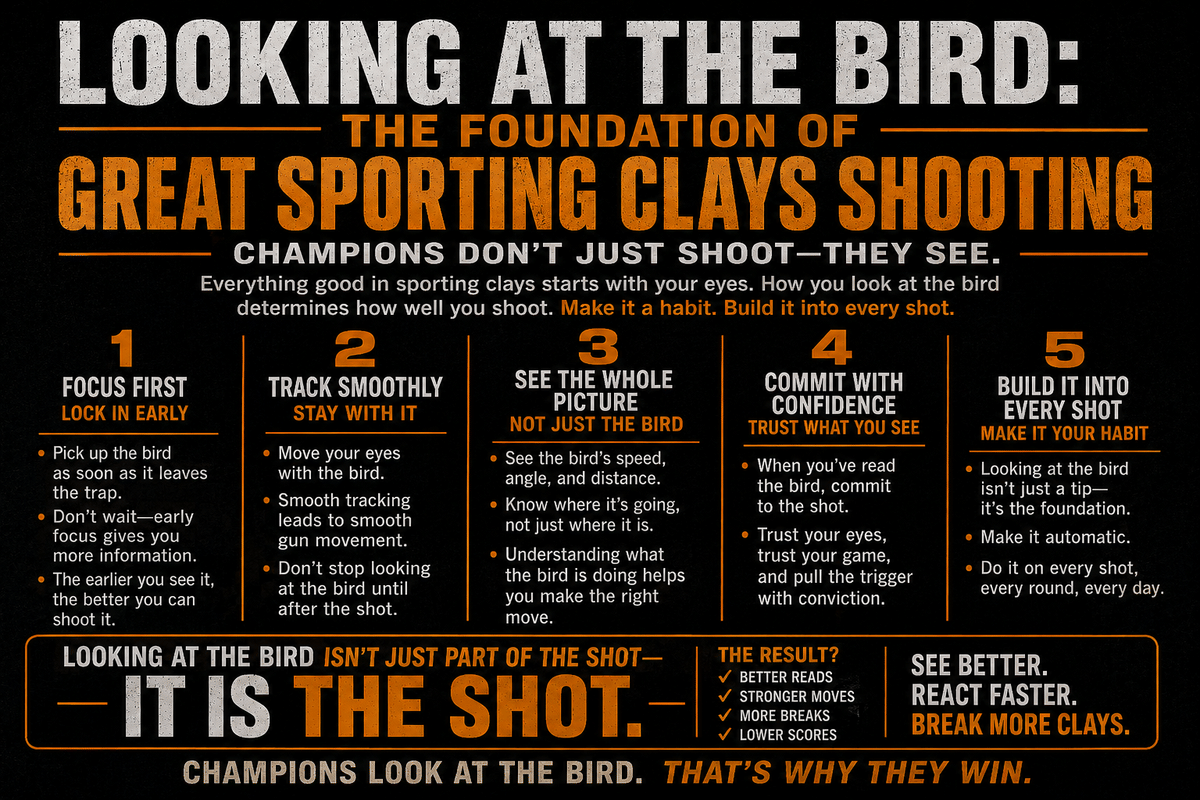
If you ask ten accomplished sporting clays shooters what single piece of advice they would give a beginner, chances are several of them would say the same thing:
"Look at the bird."
It sounds simple—almost too simple. After all, how could you hit something you aren't looking at?
Yet this deceptively simple phrase represents one of the greatest challenges in shotgun sports. Many missed targets are not the result of poor gun fit, incorrect lead, or a flawed shooting technique. They happen because the shooter stopped truly seeing the target.
Seeing Isn't Looking
Every shooter sees the clay target.
Not every shooter actually looks at it.
There's a tremendous difference.
Seeing is merely being aware that the target exists somewhere in your field of vision. Looking means directing your complete visual attention to the target with intense focus. It means your eyes are locked onto the clay, gathering information about its speed, direction, angle, and distance.
When instructors tell shooters to "look at the bird," they are asking for this intense visual commitment.
Your Eyes Drive the Shot
Unlike rifle shooting, sporting clays is not an aiming game.
The shotgun is not pointed using the front bead as a sight. Instead, your body instinctively points the shotgun where your eyes are focused.
Think about tossing a baseball or catching a football. You don't calculate trajectories or consciously move your hands. Your eyes collect information, your brain processes it instantly, and your body responds without conscious thought.
Shotgun shooting works the same way.
The eyes lead.
The hands follow.
The gun simply goes where the eyes tell it to go.
The Danger of Looking at the Gun
One of the most common mistakes shooters make is shifting their attention away from the target.
Sometimes they glance at the barrel.
Sometimes they check the bead.
Sometimes they try to measure lead.
The moment their focus leaves the target, valuable visual information disappears.
The clay continues moving.
The brain receives less information.
The swing slows.
The shot is often behind or underneath the target.
The irony is that the shooter usually believes they are helping themselves by checking the barrel. In reality, they have interrupted the natural coordination between their eyes and the gun.
Soft Eyes Become Hard Eyes
Successful sporting clays shooters use two different types of visual focus.
Before calling for the bird, they use soft eyes.
Soft eyes allow the shooter to monitor the general area where the target will first appear. Vision is relaxed and broad rather than concentrated.
The instant the target emerges, the shooter switches to hard focus.
Hard focus means seeing the target in remarkable detail.
Instead of seeing "an orange disc," the shooter begins noticing the edge of the clay, the dome, the rim, the spinning motion, and even imperfections or chips in the target.
The more detail the eyes collect, the more accurately the brain predicts where the target is going.
Trust the Brain
The human visual system is astonishingly fast.
Your brain constantly calculates speed, distance, acceleration, and direction without conscious effort.
Trying to consciously calculate lead often interferes with this natural process.
Elite shooters do not consciously think:
"This target needs three feet of lead."
Instead, they remain visually connected to the target and allow years of visual experience to guide the gun.
Even newer shooters can develop this instinct if they learn to trust their eyes instead of trying to measure every shot.
Staying Connected
Looking at the bird doesn't stop once the trigger is pulled.
Great shooters remain visually connected to the target through the shot.
They continue following the bird with their eyes while allowing the gun to keep moving naturally.
This prevents stopping the swing—a mistake responsible for countless misses.
A smooth follow-through begins with continuous visual focus.
Common Reasons Shooters Stop Looking
Several habits pull visual attention away from the target:
Looking at the bead before pulling the trigger.
Measuring lead instead of observing the target.
Watching where previous shots missed.
Anticipating recoil.
Becoming distracted by the score or the next station.
Trying too hard to "make" the shot happen.
Each distraction steals attention from the only object that truly matters—the clay.
Training Your Eyes
Visual discipline can be practiced just like mounting the shotgun.
One effective exercise is to watch targets without shooting.
Observe every detail.
Notice the spin.
Notice the changing background.
Notice how the sunlight reflects off the target.
Another drill is to call for the target while consciously reminding yourself to identify a specific feature on the clay before firing. You may not literally describe it afterward, but forcing your eyes to seek detail strengthens visual concentration.
The better your eyes become, the easier accurate shooting becomes.
Confidence Begins with Vision
Confidence in sporting clays is often mistaken for confidence in shooting.
In reality, confidence begins with vision.
When shooters know they are seeing the target clearly, they naturally become smoother, calmer, and more decisive.
The gun moves with less effort.
The swing becomes more fluid.
Timing improves.
Accuracy follows.
The Bird Is the Teacher
Every target tells you everything you need to know—if you are truly watching it.
It reveals its speed.
Its angle.
Its distance.
Its line.
Your job is not to force the gun to the target.
Your job is simply to see the target so well that your body cannot help but respond correctly.
That is what instructors mean when they say, "Look at the bird."
It isn't merely advice.
It is the foundation upon which every successful sporting clays shot is built.