
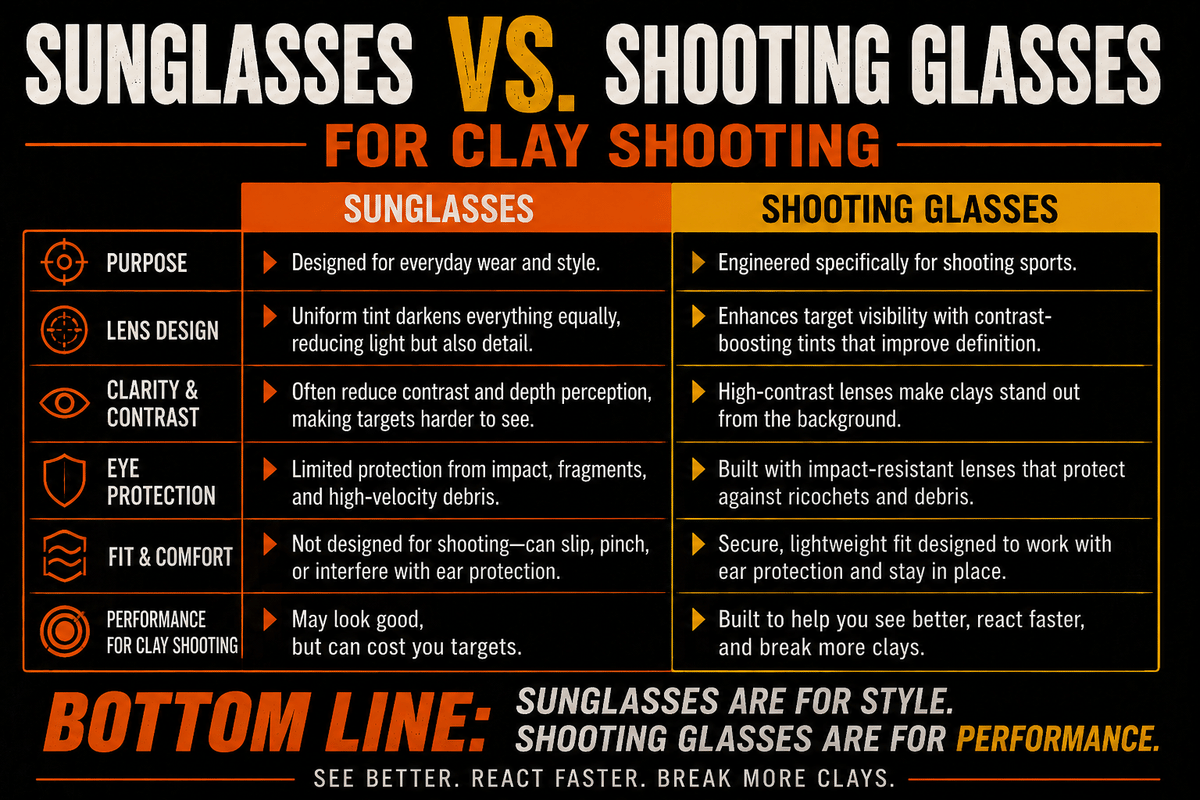
Whether you're breaking your first round of sporting clays or competing at a high level, vision plays a critical role in success. One of the most common questions new and experienced shooters ask is whether regular sunglasses are good enough, or if dedicated shooting glasses are worth the investment. While both provide eye protection from sunlight, they are designed with very different purposes in mind.
The Purpose of Sunglasses
Sunglasses are built primarily for everyday activities such as driving, walking, boating, or spending time outdoors. Their main goals are to reduce glare, protect against UV radiation, and improve comfort in bright conditions.
For general outdoor use, sunglasses perform well. However, when it comes to clay target shooting, they often fall short. Standard sunglass lenses are designed to make the world more comfortable to look at, not necessarily to help your eyes detect a fast-moving orange target traveling at high speed against constantly changing backgrounds.
Many sunglasses also use dark gray or black tints that reduce overall brightness. While this may be comfortable, it can make clay targets appear less distinct, particularly during overcast conditions, early mornings, or late afternoons.
What Makes Shooting Glasses Different?
Dedicated shooting glasses are engineered specifically for target acquisition. Rather than simply reducing light, they are designed to enhance contrast, improve depth perception, and help shooters identify the target more quickly.
Several key features separate shooting glasses from ordinary sunglasses:
Lens tints optimized for varying lighting conditions.
Enhanced contrast to make orange targets stand out against green trees, blue skies, or brown terrain.
Impact-resistant lenses designed for shooting environments.
Wraparound designs that provide a wider field of view.
Interchangeable lenses that allow shooters to adapt to changing weather and backgrounds.
These features work together to give shooters clearer visual information without excessively darkening their view.
Why Lens Color Matters
One of the biggest advantages of dedicated shooting eyewear is the availability of purpose-built lens colors.
Different environments demand different lenses. A bright, cloudless day requires a different solution than an overcast morning or a heavily wooded sporting clays course.
For example:
Purple-based lenses often enhance orange targets against green backgrounds.
Orange or amber lenses can brighten low-light conditions.
Neutral lenses may work well in extremely bright sunlight.
Specialized high-contrast lenses are designed to maximize target visibility without sacrificing detail.
Instead of simply making everything darker, shooting lenses are designed to separate the target from its background, helping your eyes lock onto the clay earlier in its flight.
Safety Considerations
Eye protection should never be overlooked in shooting sports.
Quality shooting glasses are designed with impact-resistant materials capable of helping protect your eyes from:
Clay fragments
Shot ricochets
Dust and debris
Wind and insects
While some fashion sunglasses use durable materials, not all are designed or tested for the types of impacts encountered on a shooting range. Dedicated shooting glasses are built with safety as a primary consideration alongside optical performance.
Visual Clarity Can Improve Confidence
Every shooter has experienced losing a target against a dark tree line or a bright, washed-out sky.
When your eyes can pick up the target sooner and track it more consistently, your brain has more time to process speed, angle, and lead. While no eyewear can replace good technique, clearer visual information often contributes to greater confidence and more consistent performance.
Many shooters notice that once they begin using shooting-specific lenses, they spend less effort searching for the target and more attention executing the shot.
Are Shooting Glasses Worth the Investment?
For someone who shoots only occasionally, a quality pair of sunglasses may seem sufficient. However, anyone who regularly shoots sporting clays, skeet, trap, or FITASC will likely benefit from eyewear designed specifically for the sport.
The ability to change lenses for different lighting conditions can make a noticeable difference throughout the day. Morning fog, midday sun, and late-afternoon shadows all present unique visual challenges that specialized shooting lenses are designed to address.
Choosing Premium Shooting Eyewear
When selecting dedicated shooting glasses, lens quality should be the primary consideration. High-performance optics, precise color engineering, lightweight frames, and interchangeable lens systems all contribute to a better shooting experience.
Pilla Performance Eyewear has become one of the most respected names in competitive clay target shooting because of its focus on optical performance. Their lens technology is engineered to enhance target visibility across a wide range of lighting conditions, allowing shooters to select lens colors specifically matched to the environment they're shooting in. Combined with lightweight frames and exceptional optical clarity, these features have made Pilla Performance Eyewear a popular choice among serious recreational shooters and many top-level competitors.
Final Thoughts
While sunglasses and shooting glasses may appear similar at first glance, they serve very different purposes. Sunglasses are designed to reduce brightness and increase comfort during everyday activities, whereas shooting glasses are built to enhance target visibility, improve contrast, provide impact protection, and adapt to changing shooting conditions.
For clay shooters looking to improve consistency and maximize what they see before every shot, dedicated shooting eyewear offers advantages that ordinary sunglasses simply aren't designed to provide. Investing in high-quality shooting glasses—especially a premium system such as Pilla Performance Eyewear—can help you see targets more clearly, react more confidently, and enjoy every round with greater visual precision.