
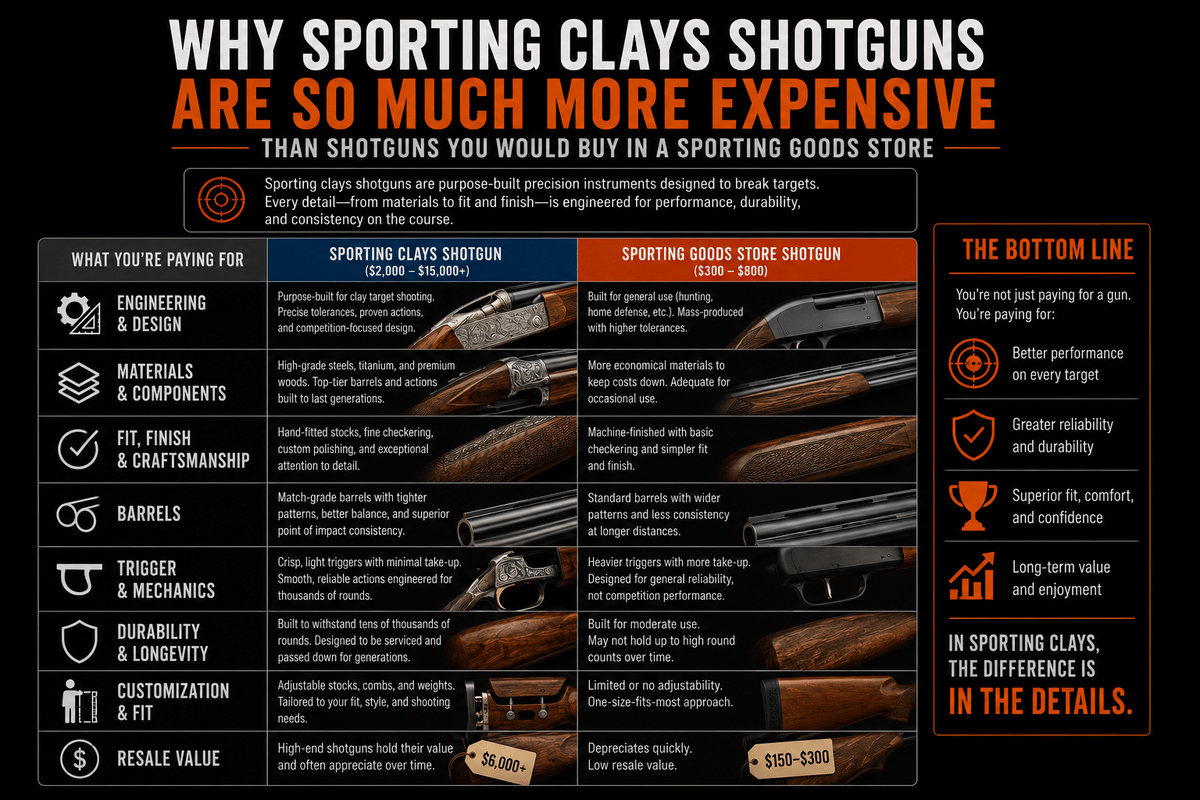
Sporting clays shotguns often surprise new shooters with their price tags. A pump-action shotgun from a sporting goods store may cost $400 to $700, while a dedicated sporting clays over-under can easily cost $2,500, $5,000, or even well over $10,000. At first glance, they all fire 12-gauge shells and break clay targets, so why is there such a dramatic difference?
The answer comes down to engineering, durability, craftsmanship, and the demands of a sport where a shotgun may fire hundreds of thousands of rounds over its lifetime.
Why Sporting Clays Shotguns Cost So Much More
Walk into any sporting goods store and you'll find plenty of affordable shotguns designed for hunting, home defense, or casual target shooting. Most of these firearms are built to serve multiple purposes and perform reliably with moderate use.
A dedicated sporting clays shotgun is built with an entirely different philosophy. Rather than being designed to fire a few boxes of shells during hunting season, these guns are engineered to withstand decades of extremely heavy use while delivering exceptional consistency, balance, and handling.
For serious clay target shooters, that difference matters every time they call "Pull."
Built for Hundreds of Thousands of Rounds
Perhaps the biggest reason sporting clays shotguns cost more is longevity.
A typical hunter may fire fewer than 200 shells in an entire year. Even an active recreational shooter might only shoot a few thousand rounds annually.
Competitive sporting clays shooters often fire:
10,000 to 25,000 rounds per year
Serious competitors may exceed 50,000 rounds annually
Some professional shooters eventually put well over 500,000 rounds through a single shotgun
That level of use destroys guns that weren't designed for it.
Manufacturers of premium sporting shotguns use stronger locking systems, hardened steel components, oversized hinge pins, replaceable wear parts, and tighter manufacturing tolerances so the gun remains mechanically sound after decades of constant firing.
Better Materials Throughout
An inexpensive shotgun is often manufactured using cast or metal injection molded (MIM) parts wherever practical to reduce cost.
High-end sporting shotguns frequently feature:
Forged steel receivers
Precision-machined internal components
High-grade barrel steel
Premium walnut stocks
Superior finishes that resist wear
These materials are more expensive before machining even begins.
Precision Manufacturing
Mass-market sporting shotguns are designed for efficient production.
Premium sporting clays guns involve considerably more machining and fitting.
Critical components such as:
Barrel regulation
Locking lugs
Hinge surfaces
Trigger assemblies
Ejectors
are manufactured with extremely tight tolerances because even slight inconsistencies can affect reliability or shooting performance over time.
Many premium shotguns also receive significant hand fitting by skilled gunsmiths.
Balance Is Everything
Competitive clay shooting demands fast, repeatable target acquisition.
A sporting clays shotgun isn't simply made lighter or heavier—it is carefully balanced.
Manufacturers spend significant effort determining:
Weight distribution
Center of gravity
Barrel weight
Receiver weight
Stock dimensions
A properly balanced shotgun moves smoothly through crossing targets, maintains momentum during the swing, and feels almost effortless to point.
This balance is difficult—and expensive—to engineer.
Better Triggers
The trigger is one of the shooter's primary connections to the gun.
Entry-level shotguns often have heavier, less refined triggers.
Sporting guns typically feature:
Crisp trigger breaks
Consistent pull weights
Minimal creep
Faster lock times
Mechanical trigger systems designed for reliability
These improvements help shooters maintain consistency during long competitions.
Superior Barrels
The barrels of premium sporting shotguns receive tremendous attention.
Manufacturers carefully control:
Bore dimensions
Chamber geometry
Forcing cone length
Barrel regulation
Internal polishing
Choke alignment
Many sporting shotguns also include interchangeable competition choke systems that produce highly consistent shot patterns across a variety of target presentations.
Reduced Felt Recoil
Competitive shooters may fire 200 to 300 shells in a single day.
If the shotgun punishes the shooter with heavy recoil, fatigue quickly becomes a performance issue.
Sporting clays shotguns reduce recoil through:
Greater overall weight
Longer forcing cones
Better stock geometry
Carefully designed recoil pads
Balanced weight distribution
The result is less fatigue and faster recovery between shots.
Adjustable Fit
One size rarely fits everyone.
Many premium sporting shotguns include adjustable:
Comb height
Cast
Length of pull
Recoil pad position
Rib height (on some models)
These adjustments allow shooters to customize the gun so it naturally shoots where they are looking.
Hand-Finished Wood
While performance is the primary goal, appearance also matters.
Many sporting shotguns feature:
Grade III through Grade VII walnut
Hand-cut checkering
Oil finishes
Beautiful wood grain
Hand polishing
Although cosmetic features don't break more targets, they represent significant craftsmanship that increases manufacturing cost.
Reliability Under Competition Conditions
During a sporting clays tournament, shooters cannot afford malfunctions.
Premium sporting shotguns are expected to:
Fire reliably for thousands of rounds between service intervals
Eject consistently
Lock tightly
Maintain point of impact
Continue functioning despite dust, heat, and extended shooting sessions
This reliability comes from careful engineering rather than simply using heavier materials.
They Are Built to Be Rebuilt
One characteristic that separates premium sporting shotguns from inexpensive models is serviceability.
Many competition guns are designed so worn parts can be replaced instead of discarding the firearm.
Items such as:
Firing pins
Springs
Locking bolts
Hinge pins
Ejector components
can often be replaced during routine maintenance, allowing the shotgun to remain competitive for generations.
Lower Production Volumes
Sporting goods stores sell thousands of entry-level hunting shotguns every year.
The market for premium sporting clays shotguns is much smaller.
Lower production numbers mean:
Less manufacturing economy of scale
More hand labor
Longer production times
Higher per-unit costs
Just as with luxury watches or custom sporting equipment, limited production contributes to higher prices.
Is a More Expensive Sporting Clays Shotgun Worth It?
For someone who shoots a few times each year, probably not.
An affordable shotgun can break plenty of clay targets and provide years of enjoyment.
However, for shooters who spend every weekend on the sporting clays course, compete regularly, or shoot tens of thousands of rounds annually, a dedicated sporting shotgun becomes a long-term investment.
The improved durability, smoother handling, reduced recoil, better fit, and consistent performance often translate into greater confidence and, ultimately, better scores.
Final Thoughts
The price difference between a sporting goods store shotgun and a dedicated sporting clays shotgun isn't simply about luxury or prestige. It reflects a fundamentally different design philosophy.
One is built to serve the occasional hunter or recreational shooter. The other is engineered to withstand an extraordinary volume of use while delivering the precision, balance, and reliability demanded by competitive clay target sports.
In the end, a premium sporting clays shotgun isn't just more expensive because of the name engraved on the receiver. It's more expensive because every component—from the steel in the action to the fit of the stock—is designed to perform consistently through hundreds of thousands of shots, often over a lifetime of competition.